
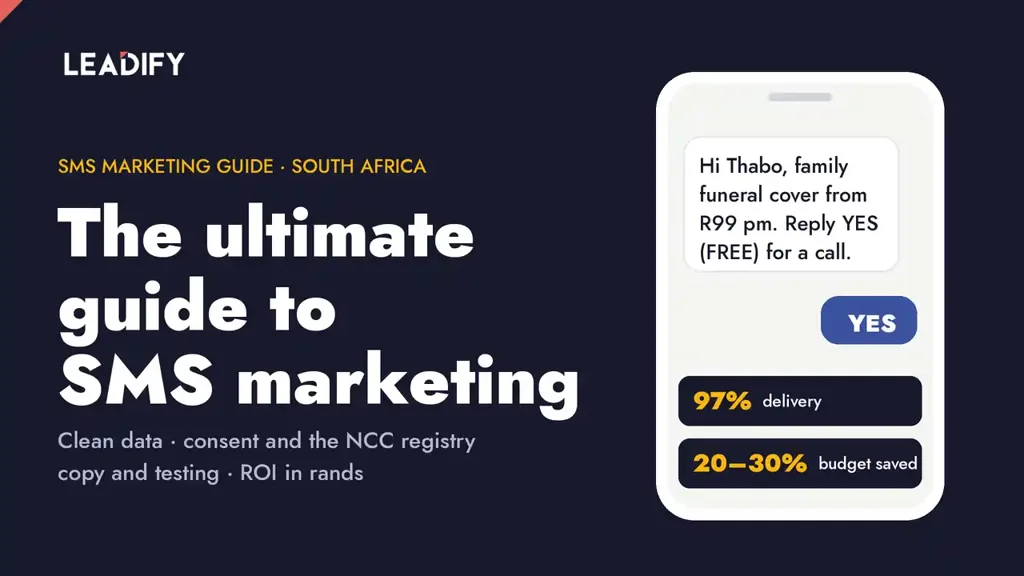
SMS marketing guide · South Africa
The ultimate guide to SMS marketing in South Africa
SMS marketing means sending promotional text messages to people who have agreed to hear from you, and in South Africa it still reaches more people, faster, than almost any other channel. But SMS isn't cheap, and the rules tightened in 2026. This guide covers what it takes to run SMS marketing that pays: clean data, consent, the NCC opt-out registry, copy, testing, timing and measuring return in rands.
SMS marketing on Leadify in numbers
850m+
SMS messages sent through Leadify a year
97%
SMS delivery with continuous data cleansing
20–30%
of SMS budget saved by clients through data cleansing alone
In this guide
- Why does SMS marketing still work in South Africa?
- Why is SMS so expensive, and where does the money go?
- How do you build and keep a healthy SMS list?
- What are the rules for SMS marketing in South Africa?
- How do you write an SMS that converts?
- How do landing pages and A/B/C testing lift results?
- When is the best time to send?
- How do you measure SMS marketing ROI?
- What happens to a lead after it responds?
- SMS marketing questions
Chapter 1
Why does SMS marketing still work in South Africa?
SMS needs no app, no data and no inbox algorithm. It lands on almost every phone in the country, smartphone or feature phone, and people read it. For financial services brands, where a single lead can be worth hundreds of rands, that directness is hard to beat.
SMS has been declared dead more than once as messaging apps grew. It keeps outliving the obituaries for a simple reason: relevance drives response. A clear, relevant offer sent to the right person still gets a reply.
The catch is that the same directness makes SMS easy to abuse. Truecaller identified 3.71 billion spam messages and 17.47 billion spam calls in South Africa in the first half of 2026 alone. People have learnt to ignore unknown numbers, and regulators have stepped in. The brands that win with SMS now are the ones that treat it with respect: consented lists, useful messages and fast, polite follow-up.
Chapter 2
Why is SMS so expensive, and where does the money go?
SMS is expensive, and lead generation means sending a lot of it. Yet most SMS platforms send to every contact with no deliverability cleansing, and on a normal database 20 to 30% of those messages fail to be delivered: numbers that have been disconnected, recycled or captured wrongly. You pay for every one of those sends and get nothing back. When a new client runs a first campaign without cleansing, delivery can be as low as 70%.
At Leadify we detest that waste, so we optimise for contactability. The platform learns over time which numbers fail, using delivery reports and consecutive failures, and holds them back before the next send. That keeps delivery at 97% and has saved clients 20 to 30% of their SMS budget. The cheapest SMS is the one you never send to a dead number.
Waste also hides in three other places:
- The same people contacted too often, so opt-outs rise and response falls.
- Lists that never rest, so every campaign hits a tired audience.
- Reports in clicks rather than rands, so nobody knows which campaign pays until the money is spent.
Chapter 3
How do you build and keep a healthy SMS list?
A healthy list is the biggest lever you have. Five habits matter most:
- Get consent the right way. Collect numbers with clear permission, recorded with the date and source. Bought lists are a fast route to complaints and fines.
- Clean before every send. Remove undeliverable numbers, duplicates and anyone who has opted out. Registered direct marketers also cleanse against the NCC opt-out registry (see the rules).
- Rest your data. Contacting the same people campaign after campaign wears them out. Rest segments between sends so each message reaches someone who hasn't just heard from you.
- Cap frequency. Set a ceiling on how often any one person hears from you across all your campaigns. Fewer, better messages keep response steady instead of spiking and then fading.
- Start broad, then segment. Don't assume you know your audience. Run a broad first campaign across several segments, compare results, then build targeted campaigns for the groups that respond.
Clean data is also what lets volume grow without the cost of waste growing with it.
“Over the past two years, Leadify has helped us to expand from an organisation that sends out a few thousand SMSes a day, to one that sends out more than a million SMSes per month.”
Sarah Nicholson, Operations & Sales Manager, JustMoney
Chapter 4
What are the rules for SMS marketing in South Africa?
Three sets of rules apply: the Protection of Personal Information Act (POPIA), the Consumer Protection Act (CPA) and its 2026 amendment regulations, and the WASPA Code of Conduct.
POPIA: consent comes first
Section 69 of POPIA prohibits direct marketing by electronic communication, including SMS, unless the person has consented or is an existing customer.
- New prospects need opt-in consent. You may ask a person for consent only once, and only if they haven't refused before. Silence is not consent.
- Existing customers can receive marketing for similar products or services if their details were obtained during a sale and they were given a chance to opt out, when their details were collected and in every message since.
- Every message must identify you and give a way to opt out. Under the CPA rules, include your business name and contact details.
The CPA and the NCC opt-out registry
The Consumer Protection Act Amendment Regulations, 2026 took effect on 15 April 2026 and created a national opt-out registry run by the National Consumer Commission (NCC).
- Register as a direct marketer. Registration opened on 15 September 2026. The NCC's launch statement said registration runs until December 2026, and its 20 October update gives 13 December 2026 as the closing date. Register now rather than wait.
- Fees for 2026: R2,574 to register and R1,930.50 to renew each year.
- Cleanse before you market. Cleansing against the registry is free from December 2026 to April 2027, then R0.12 for each blocked number found on your list. A cleansed list is valid for 30 days.
- Respect blocks, even with consent. A consumer's block on the registry overrides consent they gave earlier. Enforcement is announced from 15 April 2027, with paid cleansing and blocks from May 2027.
The NCC's guidelines were still in draft when this guide was written, so check the latest dates and fees with the NCC. Read more in The NCC opt-out registry: what changes for SMS marketers.
Permitted times
The CPA regulations prohibit direct marketing to consumers at home on Sundays and public holidays, on Saturdays before 09:00 and after 13:00, and on other days before 08:00 and after 20:00, unless the consumer has agreed otherwise.
WASPA: reply STOP
The WASPA Code of Conduct requires marketing SMSes to include a free way to opt out, such as reply STOP, and opt-outs must be honoured quickly. Make sure STOP replies flow back into your suppression lists automatically.
Getting it wrong is expensive: the National Consumer Tribunal can impose administrative fines of up to 10% of a business's annual turnover.
Our view: compliance and performance point the same way. Clean, consented, well-timed lists cost less to send to and convert better. On the lead side, Leadify Fusion lets you upload a Do Not Contact list, such as your NCC block list, and blocks every matching number before a lead reaches a buyer.
This section is a practical summary, not legal advice. Speak to your legal adviser about your situation.
Chapter 5
How do you write an SMS that converts?
A standard SMS holds 160 characters. Use an emoji or some special characters and the limit drops to 70, and longer messages are split into several billed parts. So every character has to earn its place.
- Lead with who you are. Open with your brand name so people know straight away who is messaging them. Trust drives response.
- One message, one action. Make a single clear offer with a single call to action.
- Personalise with care. A first name or a relevant detail lifts response; getting it wrong does the opposite, so only use data you trust.
- Give a genuine reason to act now. A real deadline or limited offer helps; a fake one costs trust.
- Make the next step easy. A tracked short link to a mobile landing page, or a simple "Reply YES".
- Make replies free. With reverse billing, you pay for the customer's reply. Saying "Reply YES (FREE)" removes a reason not to respond.
- Include the opt-out. "Reply STOP to opt out" is required, and it also signals that you're legitimate.
Three types of marketing SMS, and when to use each
| Type | Example | Best for |
|---|---|---|
| Reply YES | "Hi Thabo, [Brand] offers family funeral cover from R99 pm. Reply YES (FREE) for a call, or STOP to opt out." | Offers where a call centre follows up |
| Link to a form | "Hi Lerato, your business could qualify for funding up to R300,000. See if you qualify: [link] STOP to opt out" | Considered purchases where people need more information first |
| Bulk promotion | "Sarah, our year-end sale ends Sunday: up to 50% off. Shop now: [link] STOP to opt out" | Retail promotions; for leads, a reply YES or a form usually performs better |
If your call centre phones people after they respond, send an SMS first that says who will call, from which number and why. People who know a call is coming are far more likely to answer it. See Why customers no longer answer unknown numbers.
Chapter 6
How do landing pages and A/B/C testing lift results?
A message gets attention; a landing page turns it into a lead. A personalised mobile landing page can greet people by name, pre-fill what you already know, qualify interest and pass a complete lead to sales, instead of hoping someone calls back. On Leadify, more than 856,000 unique landing page leads came in during 2023 alone.
When MoneyShop moved its loan campaigns to Leadify landing pages, the forms produced 26% more loan applications than its previous form tool.
“The intelligence behind this platform has not only helped our marketing team to make faster decisions, but it has also saved us thousands on marketing costs.”
Darren Pilz, Head of Performance Marketing, MoneyShop
Testing is how you find what works. With A/B/C testing, send three versions of a message to small batches, compare the results, then send the winner to the rest of the list. Test one thing at a time: the offer, the call to action, the personalisation or the time of day. In one funeral-cover campaign, four messages were tested at about 250 sends a day; switching off the two that lost money turned a break-even campaign into more than R400,000 in profit over two years.
Replies are data too. Tag them as interested, not interested, wrong number or opt-out, and use the objections people raise about price, timing or eligibility to improve the offer. See Two-way SMS: the new performance layer for lead generation.
Chapter 7
When is the best time to send?
Start inside the legal windows in the rules, then let your own results decide. Patterns from Leadify campaigns give a good starting point:
- Mornings work well. Sends between 08:00 and 12:00 tend to perform best, when people are fresh and willing to engage.
- Midweek beats Monday. Wednesdays and Thursdays have outperformed other days by 5 to 10% in Leadify campaign data, and Monday is typically the weakest.
- Think about payday. For loan offers, send before and after payday rather than on the day itself.
- Use birthdays. Some offers come with their own date. One of our life insurance clients contacts people 11 to 14 days before their birthday, because premiums typically increase on a birthday, so it's a good moment to lock in a rate. A message on the day itself keeps the brand front of mind. Leadify runs both kinds of birthday campaign.
- Match your call centre's capacity. Call a lead back within 15 minutes of their reply; after that, the chance of converting falls fast. Never send more leads than your team can phone in that window.
Every audience is different, so test your timing like everything else.
Chapter 8
How do you measure SMS marketing ROI?
Measure in rands, not clicks. Track the full chain for every campaign:
- Messages sent and delivered
- Replies and landing page conversions
- Leads accepted by your sales team or buyer
- Sales, and revenue for every rand spent
A useful benchmark from more than 5,000 SMS campaigns run on Leadify: campaigns that convert above about 0.15% of messages sent are generally profitable. That's at least 1,500 converting leads for every million SMSes.
Leadify SMS & Email reports in financial terms, so you can see spend, leads, cost per lead, revenue and margin for each campaign while it runs, and move budget to the campaigns that earn it. Most teams only find out a month later, when someone pulls numbers from three systems.
“Leadify has changed the way our business invests in 1:1 marketing by halving our lead acquisition costs on SMS, making it our second-best performing channel.”
Aimee Bestel, Performance Marketing Manager, Mondo
Watch the bottom of the funnel too. Of 20,000 people who receive an SMS, perhaps 100 reply YES and only 15 to 30 of those become sales. Calling back fast, re-engaging leads you couldn't reach and testing new offers on people who didn't respond are often the cheapest ways to grow sales.
Chapter 9
What happens to a lead after it responds?
The campaign isn't finished when someone replies. The lead still has to reach the right buyer or call centre, quickly and in the right format. Leadify Fusion receives leads from campaigns, affiliates, APIs and forms, validates each one, holds back duplicates, blocks Do Not Contact numbers and delivers it to each buyer's system. If one buyer can't take a lead, redirection rules can send it to another, so it isn't wasted.
That's the whole journey, from first message to final delivery. Less admin. Smarter pipeline.
FAQs
SMS marketing questions
Is SMS marketing legal in South Africa?
Yes, if you follow POPIA, the CPA regulations and the WASPA Code: get consent (or market only to existing customers within the rules), identify yourself, include a free opt-out, send within the permitted times, and register and cleanse against the NCC opt-out registry.
Do I need to register with the NCC opt-out registry?
If you do direct marketing by SMS, yes. Registration opened on 15 September 2026, and the NCC's latest update gives 13 December 2026 as the closing date. Registered marketers then cleanse their lists against the registry before marketing.
How much does NCC registration cost?
For 2026: R2,574 to register and R1,930.50 to renew each year. Cleansing is free from December 2026 to April 2027, then R0.12 for each blocked number found on your list.
Can I send marketing SMSes on a Sunday?
No. Direct marketing to consumers at home is prohibited on Sundays and public holidays, and on Saturdays before 09:00 and after 13:00. On other days it's prohibited before 08:00 and after 20:00.
What SMS delivery rate should I expect?
It depends on your data. On a normal database without cleansing, 20 to 30% of messages fail to be delivered. With continuous data cleansing, Leadify's SMS delivery rate is 97%.
How can I reduce my SMS costs?
Stop paying for messages that won't arrive. Cleaning data before every send has saved Leadify clients 20 to 30% of their SMS budget.
How long can a marketing SMS be?
160 characters for a standard message, or 70 if it contains emoji or some special characters. Longer messages are split into several parts, each billed separately.
Can I market to someone who consented after they register a block?
No. A consumer's block on the NCC registry overrides consent they gave earlier.
Further reading
More on SMS marketing
SMS lead generation in South Africa
How SMS lead generation works on Leadify: clean lists, test messages, capture leads and track cost per lead.
The NCC opt-out registry
What the new registry means for SMS marketers: registration, fees, monthly cleansing and blocks.
Two-way SMS for lead generation
Use replies, questions and opt-outs as live intent data, and route warm leads to sales quickly.
Want SMS marketing that pays its way?
See how Leadify cleans your lists, tests your messages and reports every campaign in rands.