
Insights
The NCC opt-out registry: what changes for SMS marketers
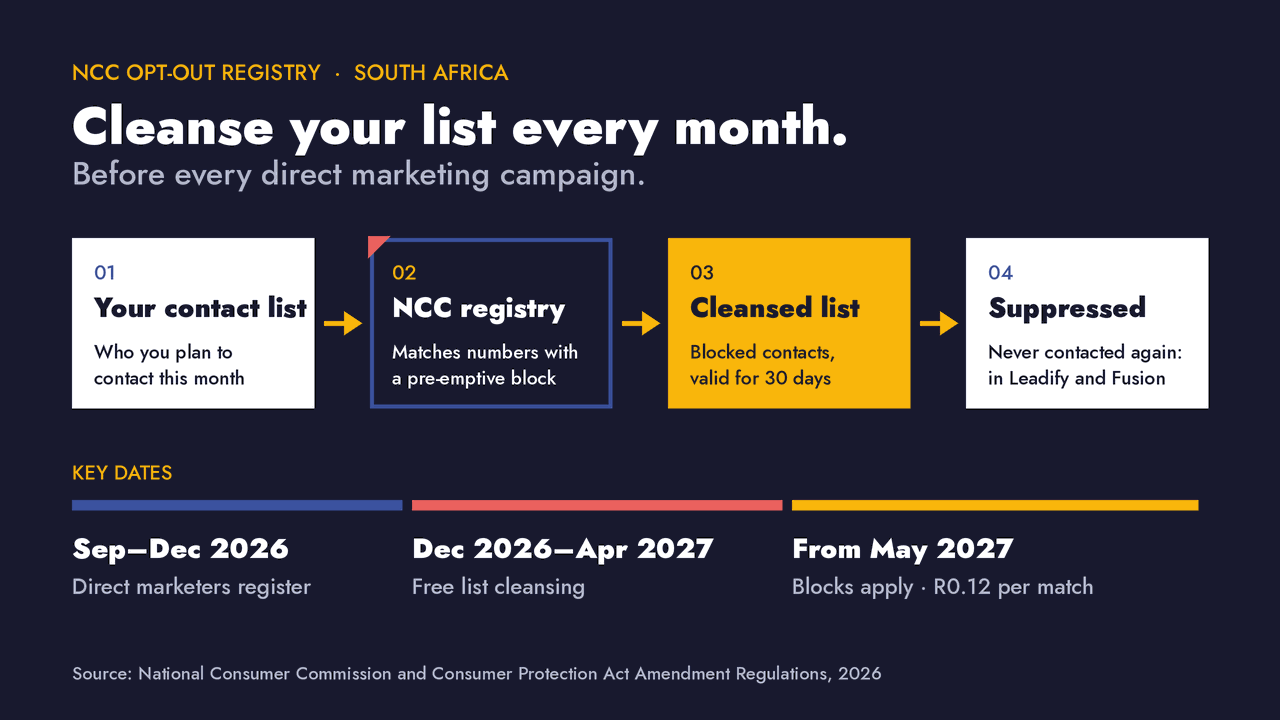
From December 2026, every business that sends marketing SMSes in South Africa needs to be registered with the National Consumer Commission (NCC) and to cleanse its contact lists against the NCC opt-out registry every month, before each campaign. Here is what the registry is, the dates that matter, what monthly cleansing involves and how Leadify handles it for you.
What is the NCC opt-out registry?
It is a national register where consumers can block unwanted direct marketing by phone call, SMS, email and other electronic channels. It was set up under section 11 of the Consumer Protection Act, and the Consumer Protection Act Amendment Regulations, 2026, which took effect on 15 April 2026, make it work in practice. The NCC runs it.
A consumer can register a general block against all direct marketing, or a specific block against particular marketers, industries, purposes or channels. Once a block is in place, it applies even if the person consented to marketing in the past, until they remove it through the registry.
The registry is not a ban on direct marketing. It is a rule about who you may not contact, and it applies to every business that markets directly, whatever its size.
What are the key dates?
15 September to 13 December 2026: registration. Direct marketers register with the NCC. The NCC's launch statement said registration runs until December 2026, and its update of 20 October gives 13 December 2026 as the closing date, so register before then. Not registering in time may be a breach of the Consumer Protection Act.
December 2026 to April 2027: free cleansing. Registered marketers can cleanse their lists against the registry at no cost.
15 April 2027: enforcement. This is the announced start of enforcement.
From May 2027: blocks apply and cleansing is charged. Consumers' blocks take effect, and cleansing costs R0.12 for each blocked consumer found on your list.
What does monthly cleansing involve?
Under the NCC's draft guidelines, published in October 2026, cleansing works like this:
Upload the list of people you plan to contact by direct marketing in the next month.
The registry checks every number and address against consumers' blocks.
You pay for each match (free until April 2027).
You receive a cleansed list showing the consumers who have blocked you.
You remove them from your marketing database.
A cleansed list is valid for 30 days, so the check has to be repeated every month and before every campaign.
What does it cost?
Registration: R2,574 (2026 fee).
Annual renewal: R1,930.50 (2026 fee).
Cleansing: free until April 2027, then R0.12 for each blocked consumer found on your list.
Getting it wrong is more expensive. The National Consumer Tribunal can impose administrative fines of up to 10% of a business's annual turnover, and the NCC can issue compliance notices.
What changes for SMS campaigns?
Consent is no longer enough on its own. A number on the registry is blocked even if that person opted in to your marketing before.
Every list needs a current check. Plan your sends month by month, and cleanse before each campaign.
Every message must identify you. Include your business name, physical address and contact number.
Your own opt-outs still count. People who reply STOP or opt out with you must stay off your lists, whether or not they are on the registry.
Built into Leadify
How does Leadify handle the NCC registry?
Cleanse in your account
Upload the NCC list
Download your contacts from your Leadify account, cleanse them at the NCC, then upload the NCC's list of blocked consumers. Leadify never sends to those numbers.
A second safety net
Cleansing by our SMS partners
Leadify's SMS providers have agreed to submit their contacts to the NCC and load the blocked numbers on their side, so registry blocks are also applied at delivery.
Across your lead routes
Blocked in Fusion too
Your NCC list and your own Do Not Contact lists also apply in Leadify Fusion, so blocked numbers are held back before a lead reaches a buyer or call centre.
When the NCC releases its API, and if it is suitable, Leadify plans to connect to it for each registered client, so cleansing can happen automatically instead of by upload and download.
A monthly routine to follow
Register now. Register as a direct marketer on the NCC's e-services portal (eservice.thencc.org.za) before 13 December 2026.
Cleanse while it is free. From December, download your contacts from Leadify, cleanse them at the NCC and upload the blocked list.
Plan sends by month. Cleanse the contacts you plan to message each month, before the first campaign goes out.
Keep records. Keep each cleansed list and the date you used it, in case you need to show you complied.
Check your other routes. If you buy or route leads, make sure the same blocked numbers apply in Leadify Fusion and with every partner.
This article is a practical summary, not legal advice. The NCC's guidelines were still in draft when it was written (25 November 2026), so check the NCC's latest notices before you rely on a date or fee.
Read more about SMS lead generation in South Africa with Leadify.
Sources: NCC, 7 October 2026; Miltons Matsemela on the NCC's 20 October 2026 update; Bowmans, 9 October 2026; Engineering News, 7 October 2026; Michalsons, October 2026.
FAQs
Frequently asked questions
When must direct marketers register with the NCC?
Registration opened on 15 September 2026. The NCC's update of 20 October gives 13 December 2026 as the closing date, so any business that markets directly by phone, SMS or email should register before then.
How often must I cleanse my contact list?
Every month, before each direct marketing campaign. A cleansed list from the NCC is valid for 30 days.
What does NCC list cleansing cost?
It is free from December 2026 to April 2027. From May 2027 it costs R0.12 for each blocked consumer found on your list. Registration costs R2,574 and annual renewal R1,930.50 (2026 fees).
Does a registry block override consent I already have?
Yes. A consumer who registers a block must not receive electronic direct marketing, even if they consented before, until they remove the block through the NCC registry.
How does Leadify help with NCC cleansing?
You can download your contacts from your Leadify account, cleanse them at the NCC and upload the blocked list so those numbers are never contacted. The list also applies in Leadify Fusion, and Leadify's SMS providers apply registry blocks on their side too.
Ready before December
Get your SMS campaigns NCC-ready
Book a demo to see how Leadify applies your NCC blocked list and your own opt-outs to every SMS campaign and lead route.