
Insights
Ask Claude or ChatGPT about your leads, in plain language
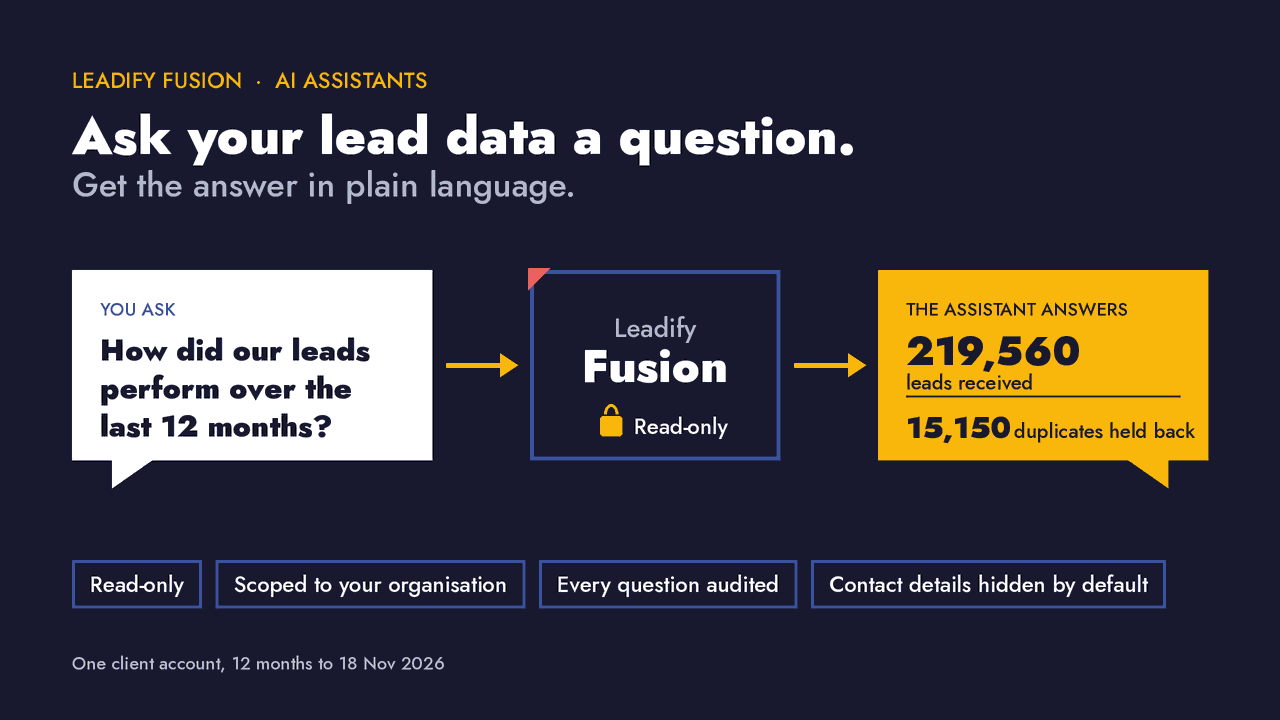
Leadify Fusion now lets you connect an AI assistant, such as Claude or ChatGPT, and ask about your lead data in plain language. Ask how many leads arrived last week, why a lead was rejected, whether a number is on a Do Not Contact list, or how a connector is set up. The assistant can only read: it can never change anything.
What can you ask?
Anything you would otherwise build a report or dig through logs to find:
“How many leads did we receive last week, by connector?”
“Why were yesterday’s leads to this buyer rejected?”
“Is this number on any of our Do Not Contact lists?”
“Which connectors are enabled, and how do they handle duplicates?”
“Who changed our connector settings this month?”
You can follow up the way you would with a colleague: “Break that down by day” or “Show me only the rejected ones”.
What does it look like on a real account?
We asked about the last 12 months on one client account. The assistant reported 219,560 leads received and 15,150 duplicates held back before they reached a call centre.
That is more than 15,000 calls agents didn’t waste, and more than 15,000 people who weren’t contacted twice. No report to build and no logs to dig through: just one question.
Is it safe to connect an AI assistant to lead data?
Yes. The connection is built to be safe by default:
Read-only. The assistant cannot add, change, resend or delete anything.
Scoped. You sign in with your own Fusion login and choose which organisation it may read. It never sees more than you can.
Private by default. Cell numbers, email addresses and surnames stay hidden unless you choose to include them. ID numbers, API keys, passwords and connector credentials are never shared.
Audited. Every question is recorded, with who asked and which organisation it was about.
Time-limited. A connection lasts 90 days, and you can disconnect it at any time.
Whatever the assistant reads is sent to the company that runs it, so connect only assistants your organisation is happy to share lead data with.
About two minutes to set up
How do you connect it?
01 · Copy
Copy the address
Open Connected Assistants in your Fusion account menu and copy the Leadify Fusion address.
02 · Add
Add it to your assistant
In Claude, add a custom connector. In ChatGPT, add a custom MCP server. Paste the address.
03 · Allow
Allow read access
Sign in to Fusion, choose the organisation the assistant may read and select Allow read access.
Why did we build it?
Automation has always been core to Leadify: taking over the repetitive work of routing, validating and reporting on leads, so your team can spend its time on the leads themselves. Leadify Fusion already validates every lead, holds back duplicates, checks Do Not Contact lists and delivers each lead to the right buyer.
AI is accelerating that automation. Asking your lead data a question in plain language, and getting a straight answer, is the next step. Less admin, smarter pipeline.
Read more about how Leadify’s three platforms work together.
FAQs
Frequently asked questions
Which AI assistants work with Leadify Fusion?
Claude, ChatGPT, Claude Code and Hermes Agent can connect today. Other assistants can’t connect yet.
Can the AI assistant change my leads or connectors?
No. The connection is read-only: the assistant cannot add, change, resend or delete anything.
Does the assistant see personal information?
Not by default. Cell numbers, email addresses and surnames are hidden unless you choose to include them. ID numbers, API keys, passwords and connector credentials are never shared.
Who can see what the assistant asked?
Every question an assistant asks is recorded, with who asked and which organisation it was about.
How long does a connection last?
90 days, after which you connect again. You can disconnect an assistant at any time in Connected Assistants, and it stops working immediately.
Less admin. Smarter pipeline.
See Leadify Fusion with your own lead flow
Book a demo to see how Fusion validates, routes and reports on your leads, and how an AI assistant can answer questions about them.